ART HISTORY / FROM REFERENCE TO TATTOO
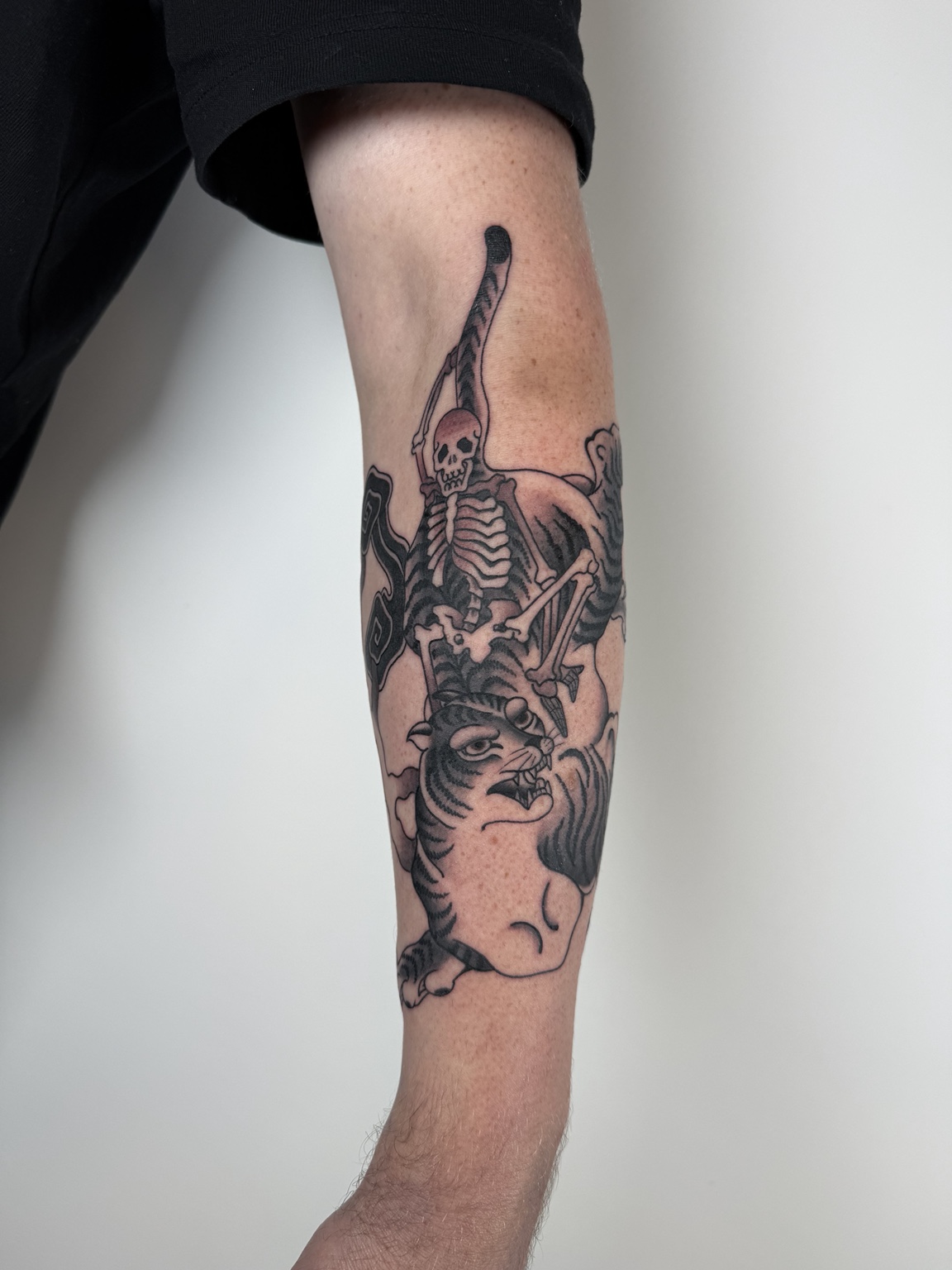
A dancing skeleton.
A slightly goofy tiger.
Kawanabe Kyōsai, the humour of the macabre, and a tattoo by Valentin at The Chamber Berlin.
The skeleton is enjoying the ride. The tiger looks a little less certain.
A raised arm, an exposed ribcage and a striped animal could make a threatening image. Here, they become an odd couple. The skeleton has the loose energy of a dancer, while the tiger’s expression brings the scene back to something friendly, awkward and unmistakably alive.
For this tattoo, Valentin names Kawanabe Kyōsai’s Dancing Skeletons as the inspiration. The relationship is about more than borrowing a skull. It is about giving bones a sense of movement and allowing an image of death to have a sense of humour. The tiger turns that idea into a new interaction, rather than a reproduction of the historical painting. [1]
Original tattoo photographs supplied by Valentin. The tattoo has not been redrawn or altered with AI.
Kyōsai: serious skill, unruly imagination
Kawanabe Kyōsai lived from 1831 to 1889, across the end of Japan’s Edo period and into the Meiji era. His training did not belong to just one visual world. The National Diet Library records an early apprenticeship with the ukiyo-e artist Utagawa Kuniyoshi, followed by training with Maemura Tōwa and Kanō Tōhaku. That background matters: his comic images were made by an artist with a disciplined drawing practice, not by someone working outside artistic training. [2]
It is tempting to make “traditional” and “playful” opposites. Kyōsai is a useful reminder that they need not be. A figure can be carefully constructed and still behave absurdly. In this article, that combination is the point of contact with tattooing: craft provides the structure in which a character can misbehave.
When the dead join the dance
The British Museum holds the hanging scroll commonly called Dancing Skeletons, dated 1871 to 1889, an interval rather than a known single year. It is a painting in ink and colour on silk, not a woodblock print. Its collection number is 1946,0209,0.48. [3]
The museum describes skeletons making music and dancing, including a seated shamisen player. Headcloths and other small accessories make the figures seem socially familiar despite their exposed bones. The result is not simply a display of death. Their actions belong to a gathering: playing, moving and enjoying one another’s company.
That is the quality Valentin picks up in his own caption: human energy surviving in an apparently lifeless figure. It does not mean every skeleton by Kyōsai has the same meaning, or that every skeleton tattoo needs a fixed symbolic explanation. Here, the important reference is a particular mood and physical gesture. [1]
THE DIRECT REFERENCE
Kawanabe Kyōsai, Dancing Skeletons
1871 to 1889 · Ink and colour on silk · British Museum
View the original painting and collection recordThe museum reproduction is linked rather than republished here. The historical tiger image below is a separate comparison, not the stated source of this tattoo.
Humour does not erase the unsettling part
A scholarly reading helps keep these images from becoming merely “spooky Japanese art.” In a 2021 study, José Rodolfo Avilés Ernult analyses Kyōsai’s 1874 Jigoku Dayū print through the concept of the uncanny, considering ambiguity, flattened space and the coexistence of macabre and satirical imagery. [4]
This is an interpretation of a different work, not an explanation proven for Dancing Skeletons or for Valentin’s tattoo. Its useful invitation is to look at relationships: what happens when familiar gestures belong to unfamiliar bodies? Our reading of the tattoo is warmer. The skeletal rider remains strange, but the tiger gives that strangeness a companion.
Kyōsai’s range is also visible in the checklist for the Suntory Museum of Art’s 2026 exhibition, Kyōsai’s World: The Israel Goldman Collection. It places animal subjects alongside skeleton parties, demons and religious figures. This is recent museum context, not a claim that a new discovery has settled the meaning of the motif. [5]
The tiger is the other half of the story
Look at the tattoo’s face before looking at its claws. The large eye, open mouth and rounded muzzle make the tiger expressive rather than simply ferocious. Above it, the skeleton balances with a bent leg and one arm stretching upwards. Neither figure feels like a still emblem. They appear caught in the middle of doing something.
This is our visual reading of Valentin’s composition, supported by his description of a slightly derpy tiger. The contrast makes the image work: the bones give it a macabre edge, the animal’s expression loosens that edge, and the rider turns the tiger from an isolated motif into part of a small scene. “Goofy” is not the absence of care. It is the character of the encounter.
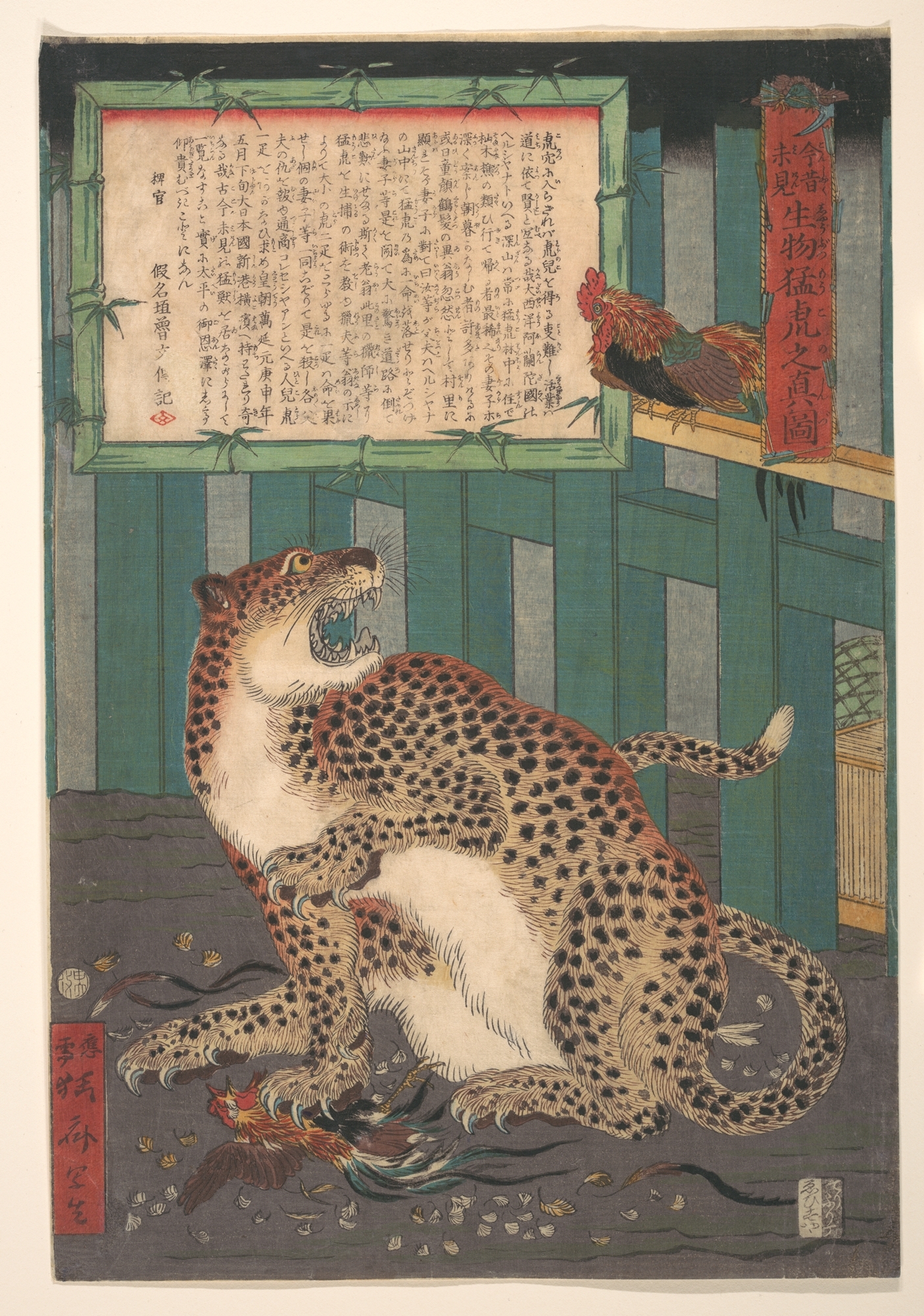
The Met’s 1860 print offers a historical comparison: another animal given a vivid presence through its face, body and surroundings. Notice the upward gaze and the birds that share its space. We are showing this work to widen the conversation around Kyōsai’s animal imagery, not claiming that Valentin copied its tiger or that the two works tell the same story. [6]
From a flat reference to a moving forearm
A painting can present its composition all at once. A forearm cannot. As the arm turns, the tiger’s body moves out of view and the skeleton, curling shapes and surrounding tattoos become more prominent. The original photographs below show why that matters. They are different views of the same tattoo, not separate versions of the design.
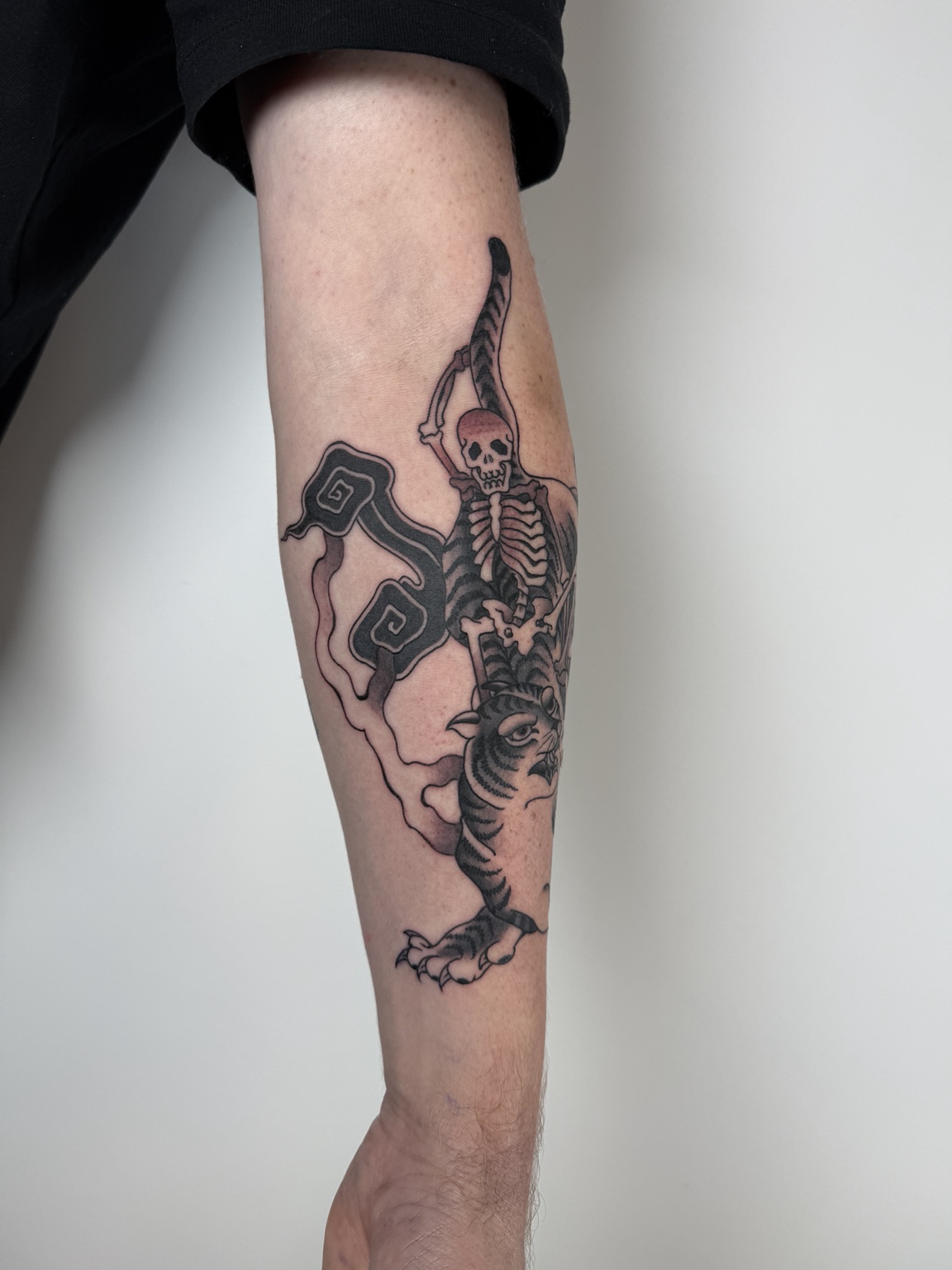
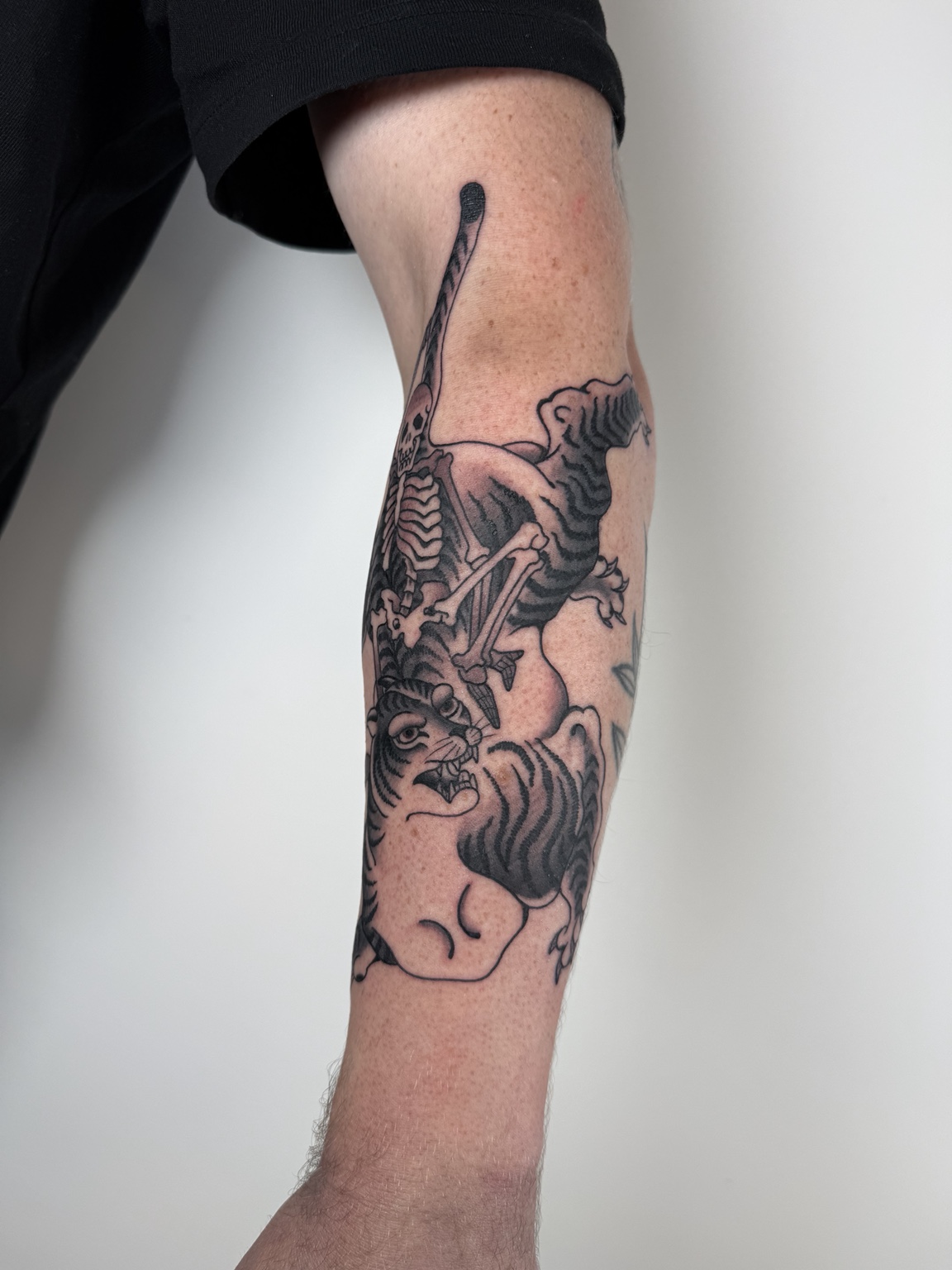
Swipe to compare the two views. Tap a photograph to see the original.
The open spaces inside the ribcage distinguish the skeleton from the tiger’s denser stripes. Broad outlines keep the main figures readable; smaller marks give them expression. Rather than carrying every detail of a historical image onto skin, a tattoo composition has to choose what will hold the scene together at its actual size and placement.
A reference can start a conversation
If you are thinking about a skeleton or tiger tattoo, bring the image that interests you and explain what you notice in it. Is it a gesture, an expression, the humour, or the contrast between two characters? Those are useful starting points for a custom composition. You do not need to arrive with a finished drawing or a universal meaning for the motif.
At The Chamber, ten years of studio practice sit alongside a continuing interest in new references, techniques and ways of drawing. Looking back at an artist such as Kyōsai is part of that ongoing learning. The aim is not to make old imagery look new by removing its context, but to understand what is compelling in it and give that idea a considered life on the body.
Talk to Valentin about an idea
Send your reference, intended placement and approximate size. Design and appointment availability are confirmed directly with the artist.
Message Valentin on InstagramSources and image credits
Historical facts are separated from our visual interpretation. Sources and image permissions checked on 10 October 2026.
- Valentin tatau. Original tattoo post, 10 October 2026. Source for the stated Kyōsai inspiration and the playful tiger concept. Tattoo photographs supplied by Valentin and reproduced without AI alteration.
- National Diet Library, Japan. KAWANABE Kyosai, Portraits of Modern Japanese Historical Figures. Biography and historical portrait. Image reuse policy: public domain images, commercial reuse permitted with source credit.
- British Museum. Dancing Skeletons, collection 1946,0209,0.48. Dating, medium and scene description. Museum reproduction not embedded.
- Avilés Ernult, José Rodolfo (2021). The uncanny and the superflat in macabre representations: Iconographic analysis of a Kawanabe Kyosai blockprint. Ritsumeikan Journal of Asia Pacific Studies, 39(01). DOI: 10.34409/rjaps.39.01_59. Analysis of Jigoku Dayū (1874), not the hanging scroll used as Valentin’s reference.
- Suntory Museum of Art (2026). Kyōsai’s World: The Israel Goldman Collection, exhibition checklist. Exhibition held 22 April to 21 June 2026. Cited as museum context, not a current exhibition announcement.
- The Metropolitan Museum of Art. Kyōsai’s 1860 tiger print, collection 2007.49.262. Historical comparison image, not a documented direct source for the tattoo. Public Domain, Met Open Access. Reproduced in full.